Home › Guides › Taiwan Travel Rule
Taiwan's Amended Travel Rule: Transfers Between Local Exchanges Now Need Both Parties' Details First
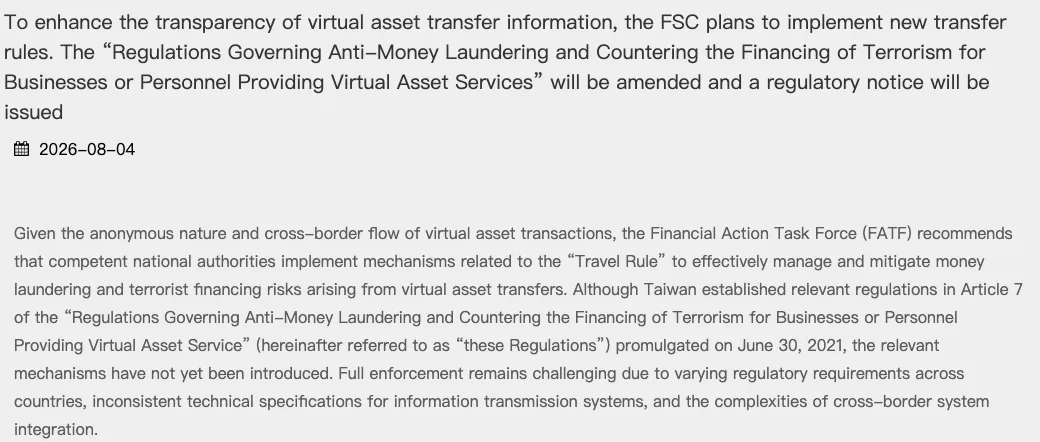
Under the Travel Rule amendments that Taiwan's Financial Supervisory Commission (FSC) promulgated on 20 October 2026, a platform must collect additional information once a virtual asset transfer exceeds NT$30,000. If the sender is a natural person, for example, that means their date of birth and residential address. With the amendments now out, moving coins from one Taiwan exchange to another means first providing the required information set out in Article 7 of the regulations; the platform carries out the transfer only after it has that information and has passed it on to the receiving side.
Transfers from a Taiwan exchange to a platform overseas fall into the second phase of the plan the FSC described in August, scheduled for the end of 2027. The October amendments set a phased timeline, and what takes effect first is transfers between Taiwan exchanges.
Is Taiwan's crypto Travel Rule in force yet?
For transfers between Taiwan exchanges, the rule applies now that the amendments have been promulgated. The Regulations Governing Anti-Money Laundering and Countering the Financing of Terrorism for Enterprises or Persons Providing Virtual Asset Services were amended in full, all 18 articles, on 26 November 2024 and took effect on 30 November 2024, except Article 7, whose start date was left to be set separately. That article on transfer information kept waiting for a start date until the FSC amended the regulations again on 20 October 2026 and said the Travel Rule for transfers between domestic VASPs would take effect once the amendments were promulgated.
Even before this amendment, Article 7 spelled out the basics. When a virtual asset service provider is the sending party, it must obtain the sender's name and wallet information plus one of three items: an official identity document number, an address, or date and place of birth. For the recipient, it needs the name and the receiving wallet information. A provider that can't meet these requirements must not carry out the transfer.
On 4 August the FSC announced a phased plan built on that article and issued a regulatory notice of the draft amendments; on 20 October, with the notice period completed, it promulgated them.
Phase one covers transfers between Taiwan exchanges; transfers abroad come in phase two
| Phase | Transfers covered | Status |
|---|---|---|
| Phase one | Between domestic VASPs | Amendments promulgated on 20 October 2026; applies from promulgation |
| Phase two | Between domestic and overseas VASPs | Planned for the end of 2027 under the August plan |
VASP stands for virtual asset service provider. The FSC published its list of VASPs that had completed anti-money laundering registration on 22 September 2025, then held repeated talks with the Taiwan Virtual Asset Service Provider Association before settling on a two-phase approach. The October amendments added provisions on scope and implementation timeline so the rule can be rolled out in phases; the end of 2027 is the timing the FSC gave for its plan in August.
Whether your transfer from a Taiwan exchange to Binance counts as one “between domestic and overseas VASPs”, and from what date it has to comply, depends on the scope and timeline the amendments added. The FSC's reminder this time concerns transfers between domestic VASPs. For transfers to platforms abroad, keep an eye on announcements from the Taiwan exchange you use.
What extra details the amended rules require for transfers over NT$30,000
The amendments add what the FSC calls an “Enhanced Threshold” information collection mechanism, which works in three layers:
- Any amount: VASPs must apply the Travel Rule whatever the value of the transfer.
- Over NT$30,000: the VASP collects additional information depending on whether the sender and recipient are natural persons or legal entities. For a sender who is a natural person, that includes date of birth and residential address; for a sender that is a legal entity, its official identification number and the address of its place of incorporation.
- Checks on the receiving side: when a VASP receives a transfer worth more than NT$30,000, it must check the recipient information supplied by the sending side against the customer information it holds.
How MAX and other Taiwan exchanges are announcing their Travel Rule rollout
MAX's notice looks at it from the user's side. Once the rule is in force, whenever users deposit or withdraw virtual assets, the platform will obtain, transmit and verify the required information on the sender and recipient; for transfers worth more than NT$30,000, it will also obtain and verify additional information based on each party's identity type. When the notice went out, all platform services and procedures stayed unchanged, with the actual launch date, scope, required information and procedures to be announced once confirmed. MAX also says it will adjust its systems and procedures to the regulator's requirements and timetable, and work with the industry association on technical integration among domestic providers.
Other exchanges will announce their own implementation details. If new fields appear when you withdraw from or deposit to Binance, fill them in truthfully as the screen asks.
Apart from the information the Travel Rule asks for, the checks before a transfer haven't changed. After pasting an address, compare its first and last characters one by one, and make sure the wallet address format matches the network; pick the wrong network and the coins may end up stuck on the wrong chain. To turn TWD into USDT and move it into Binance, you can go through a Taiwan exchange's TWD funding route; to get back to TWD, send the USDT to a Taiwan exchange and cash out there.
Will transfers to Binance be blocked, why Article 7 took so long, and who to ask
Will coins sent to Binance be blocked once the Travel Rule is in force?
A deputy director-general of Taiwan's Securities and Futures Bureau said in aCentral News Agency report on 4 August 2026 that if an overseas VASP has not implemented the Travel Rule, transfers may indeed fail to go through after the end of 2027. Whether that affects your transfers depends on the scope and timeline the October amendments set for phase two.
Article 7 has been in the regulations since 2021, so why is it only taking effect now?
In practice, the rule ran into differing regulatory requirements across countries, inconsistent technical specifications for information transmission systems and the difficulty of linking systems across borders, so the mechanism kept being held back. The move to a phased rollout is also because domestic and overseas VASPs still need time for system integration and operational adjustments.
Who can I ask about the amended regulations?
Contact the Securities Dealer Management Division of the FSC's Securities and Futures Bureau on (02) 2774-7342, or write to the FSC through its “Feedback to FSC” mailbox.